
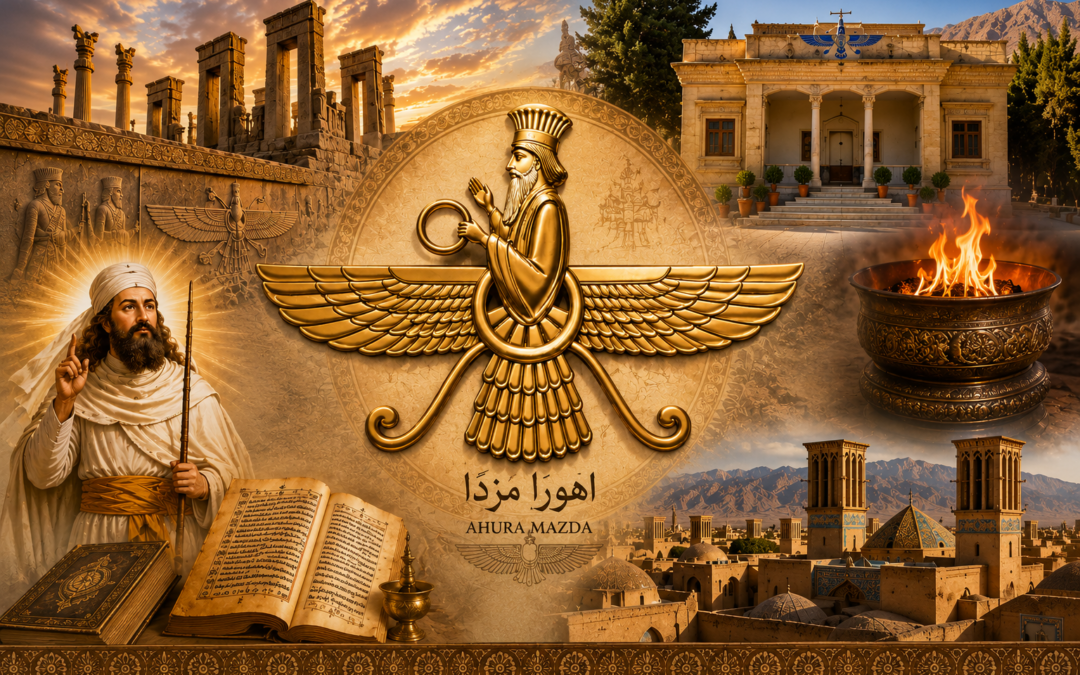
We hear about Zoroastrianism, we recognize the image of the winged figure and the ever-burning fire, and perhaps we think we know something about it. But who are the Zoroastrians really? And is it true that they worship fire?
In this month’s journey through “A Window into Cultures,” we explore an ancient religious tradition born in Persia thousands of years ago—one that survived wars, the fall of empires, migrations, and the passage of time, yet remains alive today: Zoroastrianism.
Although it is one of the world’s oldest religions, many people associate it with just one image: fire.
So, what is the story behind this ancient faith?
- Who Was Zoroaster?
Zoroastrianism takes its name from Zoroaster, also known as Zarathustra, a religious teacher and reformer who lived in the ancient Iranian world and taught belief in Ahura Mazda, meaning “Wise Lord.”
At the heart of his teachings lies a simple yet profound idea: human beings have the freedom to choose between good and evil, and they should choose the path of truth and righteousness.
Over time, this philosophy came to be expressed in three principles that remain among the best-known teachings of Zoroastrianism:
Good Thoughts… Good Words… Good Deeds.
- Do Zoroastrians Worship Fire?
This is perhaps the most common question asked about Zoroastrianism.
The answer is: No.
Fire is not a god worshipped by Zoroastrians. Rather, it symbolizes light, purity, and truth.
For this reason, fire holds a special place in Zoroastrian temples, where sacred flames are carefully tended. Worshippers pray in the presence of fire as a symbol that helps focus the mind on spiritual purity and divine truth.
Zoroastrian priests, known as Mobeds, traditionally wear white garments symbolizing purity. During certain rituals, some may also wear a white covering over the mouth, a practice intended to protect the purity of the sacred fire.
- The Winged Figure… What Does It Mean?
One of the most recognizable symbols associated with ancient Persian civilization and Zoroastrianism is the Faravahar, depicting a human figure surrounded by large wings.
Today, it is one of the best-known symbols of ancient Iranian heritage and is widely associated with the pursuit of goodness, wisdom, and spiritual growth.
Although historical interpretations of its individual details vary, the Faravahar remains a powerful visual symbol of the idea that human beings should strive to elevate their thoughts, words, and actions.
- From Persia to India
Zoroastrianism flourished for centuries in Persia, but historical changes eventually led groups of its followers to migrate. One of their most important destinations was India.
There, they became known as the Parsis, meaning “Persians.”
The Parsis preserved their religion, traditions, clothing, and rituals, while becoming an influential part of Indian society, particularly in Mumbai, despite their relatively small population today.
Among the most famous names to emerge from the Parsi community is the Tata family, one of the most prominent industrial and philanthropic families in modern Indian history.
Zoroastrian communities also remain in Iran, particularly in historic areas such as Yazd and Kerman, while other communities can be found in the United States, Canada, Britain, Australia, and elsewhere around the world.
- Traditions That Spark Curiosity
Zoroastrians have preserved many rituals and traditions across generations, including wearing white during religious ceremonies, praying in the presence of fire, and holding community celebrations that bring families together and help preserve their cultural identity.
Perhaps one of their most intriguing ancient traditions, however, is associated with what became known as the “Tower of Silence,” or Dakhma.
In ancient Zoroastrian tradition, preserving the purity of nature was considered extremely important. For this reason, traditional practices sought to avoid contaminating the earth through burial or fire through cremation.
Instead, the bodies of the deceased were placed in open, circular structures known as dakhmas, where they were exposed to natural elements and scavenger birds.
This tradition may seem unusual to us today, but it becomes more understandable when viewed within its cultural and religious context. At its heart was the belief that the natural elements should be protected from contamination and kept pure.
The ancient Towers of Silence near Yazd, Iran, still stand today, bearing witness to this distinctive chapter of Zoroastrian heritage.
- A Small Community… With a Remarkable Story
Today, Zoroastrians form a small community compared with the followers of the world’s major religions, yet they have succeeded in preserving their identity and heritage across centuries.
The sacred fires still burn in their temples. Families continue to celebrate their traditions and pass them from one generation to the next. And their ancient ethical message still carries a meaning that anyone, regardless of culture or religion, can understand:
Good Thoughts… Good Words… Good Deeds.
Perhaps that is why, after thousands of years, the story of Zoroastrianism has never faded away.
The flame they preserved was never merely a fire…
It was the memory of a culture that believed that light begins within the human spirit.