
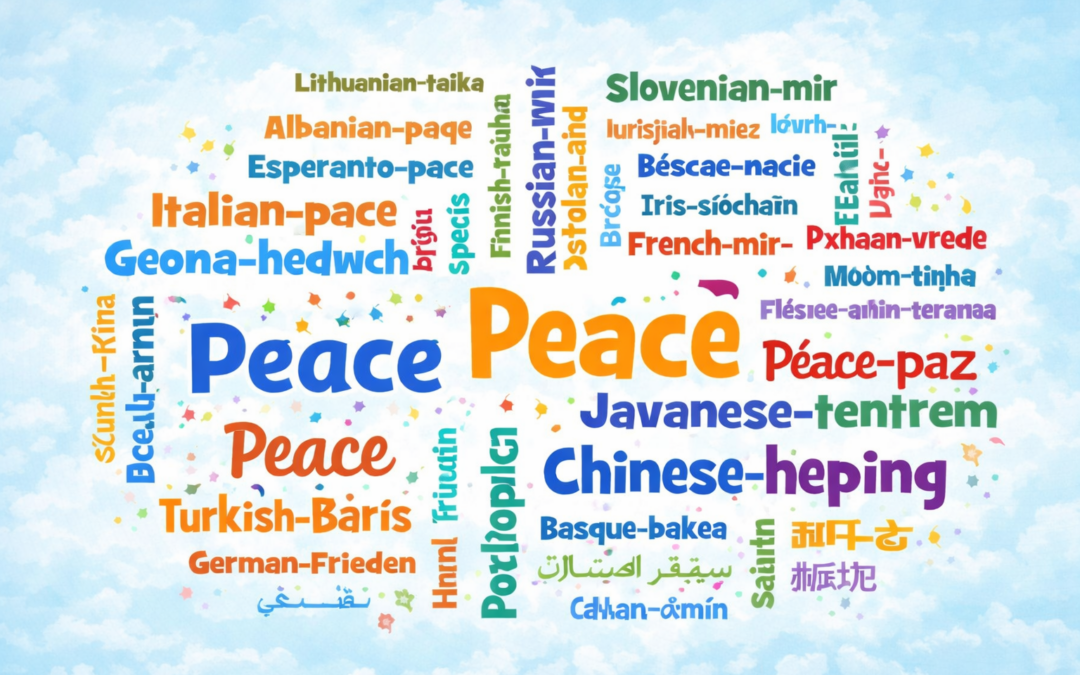
In a world where conflicts are multiplying and religions are sometimes used as a pretext for division, a simple truth often goes unnoticed: peace is the greatest common denominator among all religions.
Rituals, languages, and symbols may differ… but when we return to the essence, we discover that the message is one:
Protect the human being, so the world may live.
Peace in the Abrahamic Religions… One Language, Three Expressions
In Christianity, peace is not presented as a slogan, but as a way of life.
Jesus did not speak of peace as a wish, but as an action and a responsibility:
“Blessed are the peacemakers, for they shall be called children of God.”
Gospel of Matthew 5:9
Peace here belongs to deeds, not words—commitment, not promises.
In Islam, peace is the name, the greeting, and the purpose.
“Peace be upon you” is not merely a phrase; it is a declaration of intent:
to approach the other without harm and with a reassured heart.
At the core of the Islamic message, peace is inseparable from justice, mercy, and the preservation of human dignity.
“And Allah invites to the Home of Peace.”
Qur’an, Yunus 10:25
In Judaism, the word Shalom does not simply mean the absence of war; it signifies the wholeness of life:
peace between a person and oneself, between people, and between humanity and God.
Seek peace and pursue it.”
Psalms 34:14
Peace in Spiritual Philosophies… From Within to the World
In Buddhism, peace begins from within.
It starts with disciplining the mind, reducing attachment, and rejecting inner violence—because a troubled inner world cannot produce external peace.
“Peace comes from within. Do not seek it without.”
— Buddha
In Hinduism, peace is seen as harmony with the universe, where balance between the soul, nature, and humanity forms the foundation of stability.
“May there be peace in the heavens, peace on earth.”
— Rig Veda
Even in non-religious cultures, peace is understood as social justice, human dignity, and equal opportunity for life.
Why Does Peace Fade… Despite Its Presence in Every Message?
Perhaps because the problem was never religion itself, but those who reduce it to slogans and strip it of its human meaning.
When religion is used to justify oppression,
to sanctify power,
or to exclude the different…
peace turns from a unifying message into a broken word.
When We Need a Window… Not a Wall
In this time of global exhaustion, we need windows onto cultures—not walls between identities.
We need to see the other not as a threat, but as a partner in anxiety, in hope, and in the search for meaning.
And when religions meet on the word peace, this is not a weakness of faith—it is the strength of humanity.
Window’s Conclusion
Peace does not belong to one religion,
nor is it the slogan of a nation,
nor the luxury of stable times.
Peace is the human test… in the hardest moments.
And when we choose it,
we choose life.