It was an ordinary morning in New York.
The sky was clear and blue. People were on their way to work, and airplanes were taking off from airports as they did every day.
No one knew that this morning would become one of the most unforgettable days in modern history.
Tuesday, September 11, 2001.
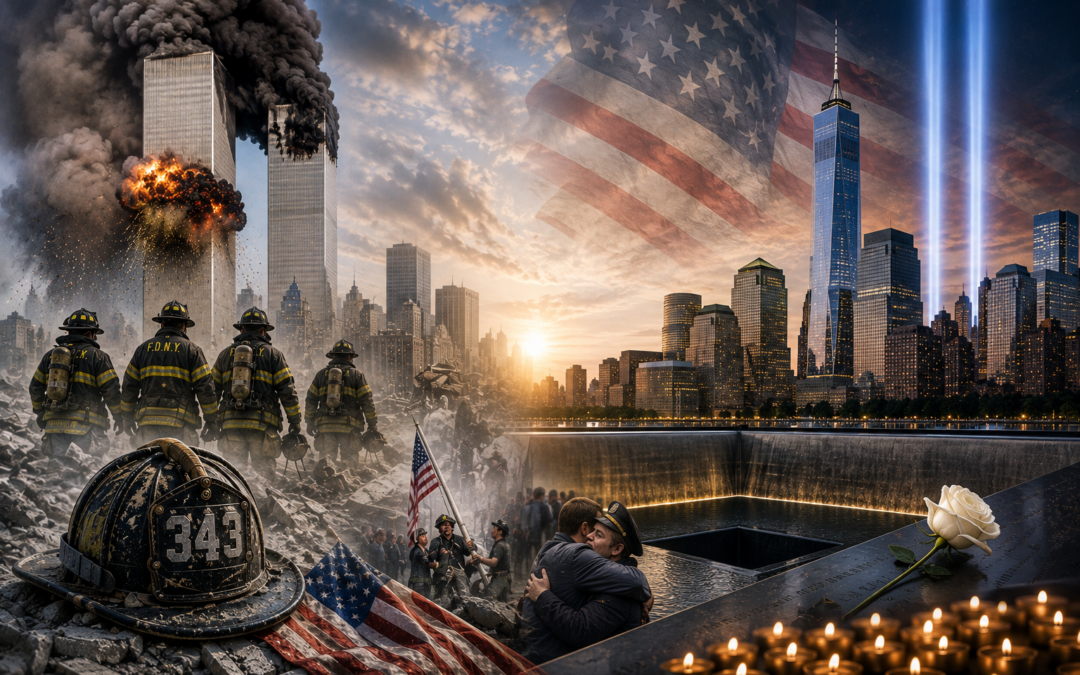
At 8:46 a.m., a hijacked airplane crashed into the North Tower of the World Trade Center. Less than twenty minutes later, a second plane struck the South Tower. There was no longer any doubt:
America was under attack.
Later, a third plane crashed into the Pentagon, while United Airlines Flight 93 went down in Pennsylvania after passengers fought back against the hijackers.
Within less than two hours, both towers had collapsed.
2,977 people were killed, and thousands more were injured.
But numbers, no matter how large, can never tell the whole story.
Those Who Went Up… While Everyone Else Was Coming Down
Amid fear, smoke, and chaos, while thousands of people were trying to escape the towers, firefighters, police officers, and emergency responders were going up. They were heading toward the very place everyone else was desperately trying to flee.
Some never came back.
In the streets, strangers helped strangers. People carried the injured, donated blood, and thousands of volunteers joined the search and rescue efforts.
That is why, when we remember September 11 twenty-five years later, we remember not only the towers that fell…
We also remember those who climbed them.
A World Before September 11… and a World After…
Some events pass through history.
Others divide history into a before and an after.
September 11 was one of them.
After that day, air travel changed. Airport security changed. American policies changed. Wars began that would continue for years, and terrorism and national security became permanent parts of the global conversation.
But a quarter century later, there is another reality worth considering.
An Entire Generation Does Not Remember That Morning
For millions of Americans, September 11 is not a personal memory.
It is a date they learned about, photographs they have seen, and a story told to them by parents, teachers, and others who lived through it.
According to the National September 11 Memorial & Museum, approximately 100 million Americans were either born after the attacks or were too young to remember them.
And so comes the question:
How do we preserve the memory of an event when a new generation has no memory of it?
Perhaps that is why the words Never Forget have become more than a slogan.
Memory does not pass from one generation to another on its own.
It must be told.
Victims Whose Stories Did Not End That Day
The consequences of September 11 did not end when the smoke cleared.
In the years that followed, firefighters, police officers, rescue workers, volunteers, survivors, and residents developed illnesses linked to exposure to the dust and hazardous substances at the World Trade Center site.
Today, the World Trade Center Health Program monitors the health of more than 125,000 registered responders and survivors.
And on the 25th anniversary in 2026, a seventh moment of silence will be added for the first time to New York’s commemoration, honoring those who later lost their lives as a result of illnesses and injuries associated with the attacks and their aftermath.
As if history itself were reminding us, twenty-five years later:
That day did not end when the smoke cleared.
25 Years Later
On September 11, 2026, the names of the victims will once again be read aloud at the place where the Twin Towers once stood.
Name after name.
Not numbers…
but names.
Behind every one of them was a family, a photograph, a story, and a life that ended on a morning that was never supposed to be different from any other.
Today, the National September 11 Memorial & Museum stands on that same ground, while One World Trade Center rises above the New York skyline.
A city rebuilt itself…
but it did not erase its memory.
Never Forget
Twenty-five years later, the face of New York has changed.
America has changed.
The world has changed.
But the responsibility of remembrance is not to pass fear, hatred, or a desire for revenge from one generation to the next.
It is to pass on the truth.
To preserve the names of the victims and the stories of courage, compassion, and solidarity that emerged in the midst of tragedy.
Because among the images of smoke and rubble, another image remains—one that must never disappear:
A human being reaching out to another human being they did not know.
Perhaps that is what Never Forget truly means.
Not only to remember how people died that day…
but also to remember how people stood beside one another when everything came crashing down.
Twenty-five years have passed.
A new generation has been born.
The towers are no longer there.
But the names remain.
The stories remain.
And the memory remains.
Because some days do not end when the sun goes down…
They stay with us, reminding us of what we lost—and of what we must never lose from our humanity.